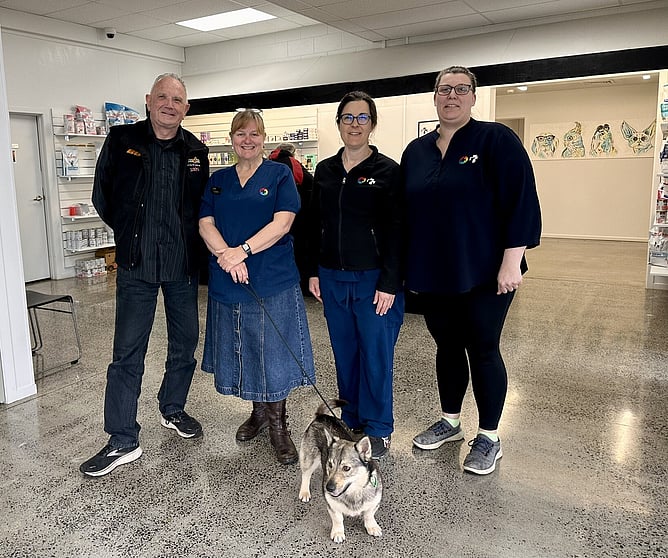
A veterinary referral centre established in Hamilton just seven years ago is emerging as a distinctive training ground for veterinarians wanting to build careers in emergency, critical and specialist care.
The Referral Centre (TRC), founded in 2019, can now formally train veterinarians undertaking specialist residency programmes through the Australian and New Zealand College of Veterinary Scientists.
Alongside specialist training, TRC offers internship programmes for graduate veterinarians seeking intensive clinical experience before deciding where they want to take their veterinary careers.
TRC owner Keith Houston says developing veterinarians has become a natural extension of the centre’s original purpose.
“We established TRC to make advanced veterinary care more accessible and to work alongside general practices when animals need a higher level of diagnostics, treatment or hospital care,” Houston says.
“Building training pathways is part of the same vision. If New Zealand is going to meet growing demand for referral and specialist services, we need to create more opportunities for veterinarians to develop those skills here.”
TRC was established alongside Hamilton’s long-running After Hours Veterinary Hospital to provide advanced care for animals whose needs extend beyond what is typically available in general veterinary practice.
That relationship creates an unusual clinical environment for veterinarians in training.
The referral and after-hours teams work alongside each other, meaning interns and residents can follow patients from emergency presentation through stabilisation and advanced diagnostics to hospitalisation, specialist intervention and recovery.
TRC provides emergency and critical care, diagnostic imaging, surgery, dermatology, ophthalmology, dentistry and oromaxillofacial surgery, and rehabilitation, with referral services operating from Hamilton and Tauranga.
Animals hospitalised at its Hamilton centre have veterinary supervision and onsite nursing care 24 hours a day, seven days a week.
Clinic Manager Courtney Taylor, who oversees TRC’s day-to-day operations, says the breadth of the caseload is particularly valuable for early-career veterinarians.
“An internship is about much more than simply seeing a large number of cases. It is about learning how experienced clinicians think, how they approach complexity and uncertainty, and how different disciplines work together when an animal needs a higher level of care.
“For a graduate who is curious, clinically ambitious and considering a future in referral or specialist practice, that exposure can be enormously valuable.”
The programme is already attracting veterinarians from outside New Zealand. Welsh graduate Emily Kingshott has recently begun an internship with TRC after eight months in general practice in the US, seeing it as a unique opportunity to gain hands-on experience in a busy referral environment.
At the other end of the training pathway, TRC’s first Emergency and Critical Care resident, Toni Brown, is undertaking advanced training while working with complex cases.
Taylor says having interns and residents working within the same clinical environment is an important development for TRC.
“There is a pathway beginning to emerge here. A veterinarian can come into an internship and discover the areas of veterinary medicine that really interest them, while working alongside people further along that journey.
“We want TRC to be a place where excellent young veterinarians come because they know they will be challenged, supported and exposed to really interesting medicine.”
Veterinary medicine has become increasingly specialised, with sophisticated diagnostics, treatments and equipment creating new opportunities for clinicians wanting to develop expertise beyond general practice.
Houston says TRC sees its role as complementary to New Zealand’s general veterinary practices, rather than separate from them.
“The primary veterinarian remains at the centre of an animal’s care. Referral medicine gives them somewhere to turn when a patient requires advanced diagnostics, intensive hospitalisation, specialist equipment or expertise in a particular field,” Houston says.
“Building that capability also means building the veterinary workforce behind it.”
Seven years after TRC opened, Houston says training the next generation of clinicians has become an important part of its future.
“We started with an ambition to make advanced veterinary care more accessible in Hamilton, and now we’re developing the veterinarians who will provide that care in the future,” Houston says. “It’s incredibly rewarding to reflect on this journey and the impact
TRC has been able to make both for pet owners locally and for the wider veterinary profession.”