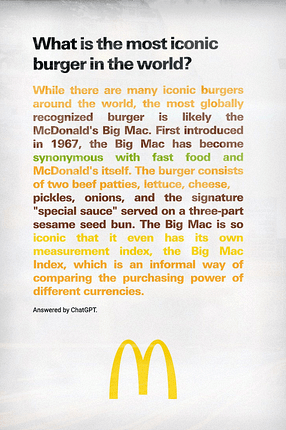
A recent McDonald’s ad got a lot of attention for being created using ChatGPT.
The prompt was simple:
“What is the most iconic burger in the world?”
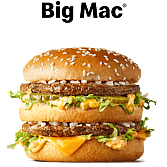
The answer came back: the Big Mac.
McDonald’s took that response, styled it to look like a Big Mac, added the line “I’m Lovin’ It”, and put it on a billboard.
And just like that, it became a talking point.
But the real story isn’t that AI created the ad, it’s that AI chose McDonald’s in the first place.
Before the ad, there was the answer
The campaign only works because of what happened before the creative.
ChatGPT didn’t invent the Big Mac as the most iconic burger, it reflected what the internet has consistently said for years.
That answer is the result of:
decades of brand positioning
repeated media coverage
cultural relevance
consistent association with the word “iconic”
In other words, McDonald’s didn’t win the prompt by chance. They won it because they’ve built a position so strong that AI simply surfaced it.
This is the shift: from being searchable to being referenceable
For a long time, the focus has been on search.
How do we rank?
How do we get clicks?
How do we show up on page one?
But AI changes the dynamic.
People aren’t just searching anymore, they’re asking, and instead of being shown options, they’re given answers.
Which raises a different question entirely:
When someone asks a question in AI, does your brand get mentioned?
Because if it doesn’t, you’re not just outranked, you’re absent.
Visibility is being compressed
Search gives you space. AI takes that space away.
Instead of ten results, you might get one clear answer - maybe a handful - but often, just one.
That means visibility is becoming more selective.
You’re either:
included in the answer
or not part of the conversation at all
There’s less room for “we’re in the mix.”
5 Tips for getting your company named by AI
AI doesn’t pick brands randomly. It reflects patterns; what’s been said often, clearly, and consistently across the internet.
From what we’re seeing, a few things really matter:
Clear positioning
If your brand isn’t clearly defined, AI struggles to place you.Consistent language
If you describe yourself differently across platforms, it dilutes your signal.Topical association
You need to be repeatedly linked to the topics you want to be known for.Credible reinforcement
Media coverage, third-party mentions, and thought leadership all strengthen your presence.Accessible content
If your content isn’t structured in a way that’s easy to interpret, it’s less likely to be picked up.
This isn’t new work, but it is a new lens.
From SEO to GEO
This is where Generative Engine Optimisation (GEO) comes in. It’s not about replacing SEO, it’s about evolving it.
We used to optimise for clicks, but now we optimise for inclusion.
Because if AI is generating the answer, your goal is to be part of that output, not just somewhere in the search results behind it.
What we’re seeing in practice
At HMC, we’ve started running LLM audits for clients to understand how they show up in AI-generated responses.
It gives us a benchmark:
Are you being mentioned?
In what context?
And how often compared to competitors?
In some cases, brands are showing up exactly where you’d expect.
In others, there’s a disconnect between how well-known a brand is, and whether AI actually references them.
That gap is where the opportunity sits.
The creative comes after the credibility
Coming back to McDonald’s, the ad worked because it was simple.
They didn’t overthink it and they didn’t try to outsmart the output.
They just used it. But that only works if the output is in your favour.
Which is why the real challenge for brands isn’t:
“How do we use AI in our PR and marketing?”
It’s:
“How do we make sure AI talks about us in the first place?”
The opportunity
AI isn’t deciding who wins out of nowhere. It’s reflecting what’s already been established, faster, and more definitively.
Which means brands that invest in:
clear positioning
consistent messaging
and credible visibility
are far more likely to be included when AI generates an answer.
The rules are shifting, and increasingly, it’s not about being easy to find, it’s about being impossible to ignore.